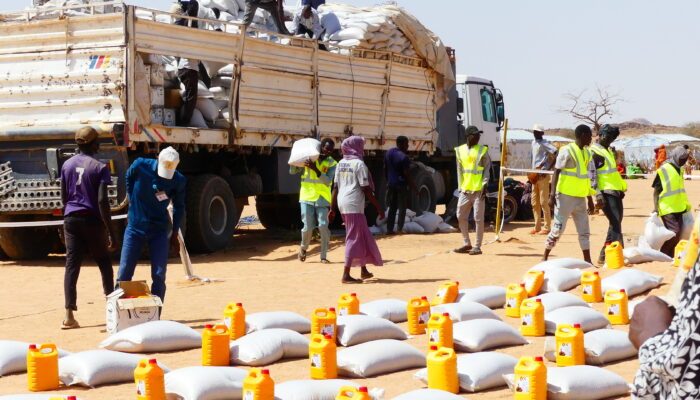
Food distribution in Farchana Camp for Sudanese Refugees (2025)
Despite their decades long existence, a large share of refugee camps continues to be served by humanitarian assistance. Generations have grown up in places that were never meant to last and therefore lack opportunities for them to build a future. Around 6.6 million displaced people find themselves in this situation, representing an enormous loss of capacity and a lack of dignity. There is reason to question why this situation pertains and what is hindering the transformation of camps into more dignifying and sustainable spaces. This round table aims to untangle what is actually happening in camps, how their politics are shaped, and whether humanitarian actors play a role in their perpetuation. It will also look at opportunities for transforming the situation towards more durable opportunities.
Camps are sites of tension, in which there is friction between the lived reality of refugees, humanitarian operations and the institutional context of host governments. Yet camps have also been sites of modest innovation and entrepreneurial opportunities. They also contribute to regional economies, for example through remittances. In a time of budget cuts there is renewed emphasis on self-reliance of people in camps, but the question is how feasible this is considering the circumstances. Paul Collier argued in his book Refuge in 2017 that there should be a heavy investment in camps so that they can be self-reliant. Should that call be revisited? The response needs to take into account how reasonable and desirable it is to frame refugee camps as development opportunities.
There are initiatives that aim to transform camps from humanitarian sites to permanent urban areas. Some refugee camps already function as de facto cities, but without the systems that make cities thrive – energy, jobs, circular economies, and representation. A notable example is the Sharika-plan of the Government of Kenya. Uganda’s refugee model has been praised for long as exemplary. Its underfunding against rising refugee flows, however, are putting it under heavy stress at present. In this session, academics, practitioners and governmental representatives will seek to critically reflect on the role of humanitarians in refugee camps and draw lessons for ongoing responses.
Please register via webform.
– Picture: HELP Chad/Stiching Vluchteling –