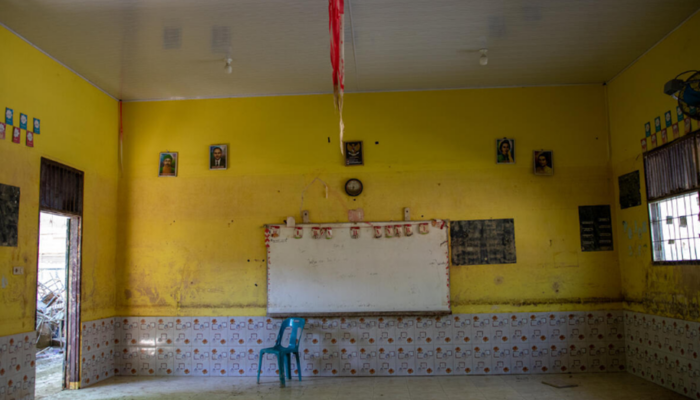
Classroom filled almost completely by water and mud during recent floods in Aceh, Indonesia.
Please find the report of the conference here.
2025 has seen immense shocks to humanitarian action across the globe, affecting budgets, responders and the space to respond, with major implications for those affected by conflict and crisis. States approach humanitarian action more explicitly for geo-strategic purposes and humanitarians are increasingly under attack. This raises questions about the very foundation of principled action. KUNO will host the Dutch humanitarian field – practice, policy and research – and its in-country partners in a conference that aims to facilitate meaningful exchange around tough dilemmas, and to offer perspectives for joint action.
In guided settings, participants will unpack the politics around humanitarian action. They will explore new tough dilemmas that they see themselves confronted with. For example, will organisations continue to try and reach excluded communities after prioritisation, or will they focus completely on those that were included? Should practitioners engage with ‘new modalities’ that integrate political, military, corporate and humanitarian aims, or place a firewall around them? Do the major investments in defence require humanitarians to engage more closely with armies? How tight should the humanitarian principles be upheld when operational and funding restrictions are being imposed?
These and other dilemmas call for reflection in a closed and safe setting. KUNO, Save the Children, and Van Hall Larenstein University of Applied Sciences, therefore, invite you to meet colleagues in the Dutch humanitarian field to gain insights and perspectives for action on the changing role and mandate of humanitarian actors.
Thematic streams
- Funding shocks: people at risk of being left behind
- To be silent or not to be silent? The ethics of remaining principled
- Erratic geopolitics: the humanitarian system undermined
- How defence investments affect humanitarian agendas
09:00 Arrival and registration
09:30 Plenary opening
10:00 Presentation by Mike Pearson and keynote conversation between Amina Abdinoor, Abdurahman Sharif, and Dirk-Jan Koch
11:45 Lunch
13:00 Parallel streams
15:30 Coffee break
16:00 Conversation with Nathalie Olijslager-Jaarsma
17:00 Network drinks
A more detailed programme can be found here.
Send an email to kuno@kuno-platform.nl for more information
– Picture: Save the Children, Sacha Myers –
Funding shocks: people at risk of being left behind
The humanitarian sector is facing a funding crisis with budget shortfalls of 30–60%. The steep decline in funding is forcing humanitarian actors into so-called ‘hyper prioritization’, leaving out tens of millions of people in need that are not targeted for aid. The most consequential trend of hyper prioritization is the explicit transition away from the international humanitarian system in many contexts. This session will explore who are the people that are left out, what happens to the people who are not prioritized and how vulnerable groups can continue to receive support despite global budget cuts.
During last year’s conference, participants discussed which logics guide prioritization. This year’s conference will focus on its consequences and on how to ensure humanitarian actors are not leaving gaps. Questions that will be raised include ‘Should resource allocation adhere to the hyperprioritization exercise, potentially limiting reach to the most vulnerable?’ and ‘Is it justifiable to prioritize a less vulnerable group in order to reach more people as this is more cost-efficient?’ The aim is to bridge research and practice and to develop a set of practical recommendations for policymakers and practitioners.
To be silent or not to be silent? The ethics of remaining principled
The humanitarian principles are under pressure due to the increasing entanglement of politics and humanitarian action. (I)NGOs and UN agencies are facing operational restrictions, for example in the North of Yemen, Afghanistan and the Sahel. Funding conditions are on the rise, which are juxtaposed to the principles of humanity and impartiality, or provided by donors who are also (in)directly fuelling conflict. Not only does this lead to ethical dilemmas, but it also undermines the legitimacy of humanitarian action. It raises the questions what the red line is for humanitarian actors and what impact these trade-offs have on affected people.
The humanitarian principles are at the core of humanitarian work. However, in a time of increasing conflict and disregard of international humanitarian law, there is a growing discomfort with staying silent in the face of atrocities. International and local actors face the question to what extent particularly the principle of neutrality is compatible with speaking out about violations of International Humanitarian Law. The conference will facilitate exploring ethical dilemmas in a guided format. Participants will make informed decisions on the application of the humanitarian principles and discuss the consequences these decisions have on people in need.
Erratic geopolitics: the humanitarian system undermined
Should humanitarian actors engage with new modalities that are conflicting with the humanitarian principles, like the Board of Peace, when it increases its reach and budgets? How to respond when humanitarian funds come tied to severe conditions, like the US budget for UN OCHA, what are the red lines? These are just two dilemmas that humanitarians face every day in a context in which politics and humanitarian action are getting more entangled.
Amidst shifting and increasingly erratic geopolitics, humanitarian action is increasingly undermined by eroding norms, restrictions or strategic instrumentalization by states and other actors. International Humanitarian law is overruled, and the humanitarian principles offer continuously less protection, resulting in increased needs and eroded capacities of affected communities. Military and political strategies are deliberately targeting civilians, civilian infrastructure such as hospitals and schools, and aid workers. Political pressure is also manifesting in what may be understood as ‘new modalities’ of aid delivery, including those that mix public, private and military interests.
Is there a collective effort that can be pursued to counter the undermining of the humanitarian system? This stream will explore and unpack these rapid changes, to increase the understanding and to find the added value of ‘the Dutch humanitarian field’ in addressing concerns.
Global militarisation, rising defence investments and the effect on humanitarian action
The growing number of conflicts and armed actors worldwide, together with increasing defence expenditures, reflects a broader trend of militarisation. Defence spending is at a peak high, mainly due to rising budgets across Europe and Canada as part of the NATO agreement. At the same time, global support for peacekeeping missions is declining. Over the past decades, good practices to safeguard civilians have been developed, however, they risk being undermined the swift shifts in military agendas and budgets. These trends strongly affect humanitarian needs and responses, particularly in combination with the growing disregard for International Humanitarian Law. This raises serious concerns about the protection of civilians, including humanitarian workers.
This stream explores key dilemmas humanitarian actors face in response to growing militarisation and rising defence investments. It aims to facilitate exchange on whether and how organisations have made decisions and taken action. If so, what do they entail? Which considerations and weighing of interests have guided the defining of positions or identifying of measures? Knowing that these questions are prominent within organisational headquarters, this session offers a safe space for participants to exchange emerging ideas, doubts, questions, and concerns. It does not seek to find ‘solutions’ or a collective positioning, but rather to sharpen the thinking on how to approach these sensitive and complex issues.