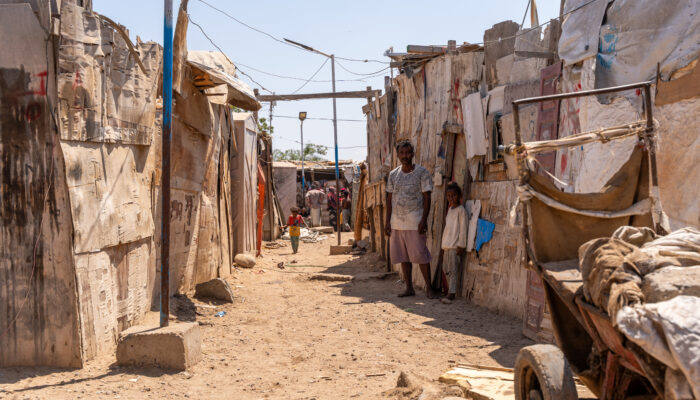
IDP Camp in Dar Saad (Aden)
The conflict that started in 2014 between the Internationally Recognized Government of Yemen (IRG) and the Sana’a-based de facto authority (DFA) in the north of Yemen (also known as the Houthis) has resulted in a severe economic and humanitarian crisis, one of the worst and most neglected in modern history. The conflict fragmented the nation into two main areas of political and economic control. In the newly published 2026 Yemen Humanitarian Needs and Response Plan (HNRP), it states that in 2026, 22.3 million people require humanitarian assistance and protection services. This includes 5.2 million internally displaced people, alongside migrants and refugees. The latest IPC analysis points to a further deterioration in food security, with 18.3 million people now being acutely insecure. The country is also grappling with deep environmental and climate crises. Despite the scale of need, funding remains critically insufficient. While roughly 70% of humanitarian needs in Yemen are concentrated in the north, operational space for aid agencies is only decreasing, with access constraints and deteriorating security conditions increasingly limiting the reach of humanitarian actors.
KUNO invites representatives of NGOs (international and local/national), academics and Dutch MFA officials to come together to exchange knowledge and perspectives on the pressing challenges facing humanitarian response in Yemen. The session aims to foster dialogue and identify opportunities for more effective action.
Preliminary discussion points (not limited to):
- Humanitarian needs update (including emerging evidence of alarming food insecurity levels and the implications for response priorities.
- Humanitarian access and operational conditions in the north – including restrictions on humanitarian access, the safety and security of humanitarian workers, and updates on the operational presence of international and local organisations.
- Impact of political and geopolitical developments – including the consequences of the Foreign Terrorist Organization (FTO) designation; international budget cuts; and the regional conflict and spillover, on the capacity of humanitarian response.
- Efforts for sustainable interventions – while humanitarian response in Yemen remains largely focused on lifesaving interventions, what opportunities exist to strengthen linkages with development and peacebuilding activities? How can actors move beyond siloed approaches toward more integrated, longer-term programming, including through anticipatory action?
This session will be moderated by Muna Alhammadi, MENA regional coordination team member and Co-Focal point, Women and Gender Constituency (WGC)
– Picture Stichting Vluchteling, Réne van Beek –